The short version
- Why: density, glue and harmonics that help on small speakers.
- Where: before the final limiter.
- How much: a little, often with a reduced mix.
- Watch out for: mud in the low end, harshness in the highs, lost transients.
- Always: compare at the same loudness.
What saturation really brings to a master
Saturation adds harmonics and gently rounds off the peaks. On a whole mix, that has three effects. The elements seem more connected, as if they shared the same space. The sound seems denser and a little louder at the same peak level. And the added harmonics help the low end and the mids stay audible on phones and small speakers.
The flip side: too much saturation thickens the low end, makes the highs harsh and softens the transients that give the mix its punch.
Where to place it in the chain
| Position | Role |
|---|---|
| 1. Corrective EQ | Fix the balance before adding harmonics |
| 2. Bus compression (optional) | Glue the dynamics |
| 3. Saturation | Density, color, harmonics |
| 4. Limiter | Control the final peaks and the loudness |
Many producers also put a light saturation on the mix bus from the start of the mix and "mix into it". The balance then takes the color into account from the beginning.
Choosing the character
| Character | Effect on a master | Typical use |
|---|---|---|
| Tape | Rounded peaks, glue, soft highs | Pop, rock, hip-hop, most genres |
| Tube or soft | Warmth, density in the mids | Acoustic, soul, jazz, vocals in front |
| Console | Subtle cohesion between the elements | Dense mixes with many tracks |
| Distortion, fuzz | Obvious effect | Rarely on a whole master, except as a creative choice |
The method in 6 steps
- Start at zero: drive at minimum, mix at 100%, then raise the drive until you hear the change, and back off a little.
- Reduce the mix: blending the saturated signal with the dry signal keeps the transients and the clarity.
- Protect the low end: the low end saturates first and gets muddy. Keep it tight.
- Watch the highs: added harmonics can make cymbals and sibilance harsh. Add presence carefully.
- Match the output level: saturation raises the level. Compensate so the bypass and the processed version play at the same loudness.
- Check through the limiter: the limiter reacts differently to a saturated signal. Listen to the whole chain, not the saturation alone.
Doing it with Anadrive
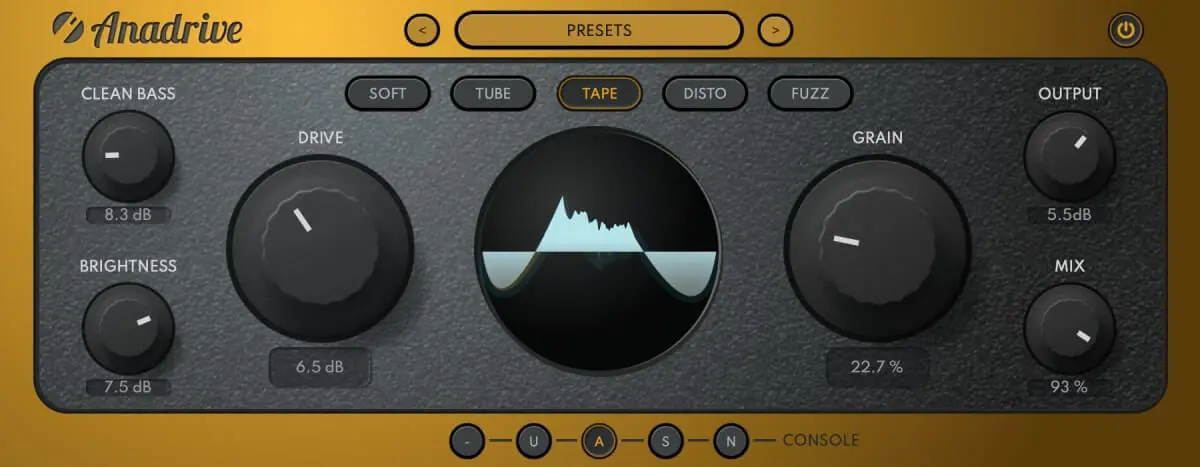
Anadrive covers each step of this method. TAPE or SOFT for a master, or the CONSOLE mode for cohesion. DRIVE sets the amount, MIX blends with the dry signal, CLEAN BASS keeps the low end tight while the rest saturates, and BRIGHTNESS adds presence through harmonics rather than through an EQ boost. GRAIN adds texture without increasing the saturation, useful when you want character but not more density.

Anadrive
Analog saturation that keeps your low end punchy.
$49 $98 -50%
VST3 · AU · AAX · Windows & macOS
See AnadriveJudging without being fooled
A saturated master is a little louder, and louder always seems better. That is the most common trap. Compare the bypass and the processed version at the same loudness, ideally blind. Diffonic matches the loudness automatically and offers a blind test with a final score: if you cannot tell the versions apart, the saturation is not adding much.
When not to saturate the master
- The mix is already very dense and saturated track by track.
- The genre needs clean, wide dynamics, such as some classical or acoustic music.
- You hear distortion clearly at a reasonable listening level.
- The level-matched comparison shows no improvement.
In short
Saturation on the master is a seasoning: a little brings density, glue and presence, too much costs punch and clarity. Place it before the limiter, keep the drive low, protect the low end, watch the highs and always compare at the same loudness. See also the best saturation plugins, the best mastering plugins and our comparison Anadrive vs Decapitator.
Frequently asked questions
Should I put saturation on the master?
It can help: a little saturation adds density, glue and harmonics that make the mix more present on small speakers. It is not mandatory. If the mix is already dense, or if the genre needs very clean dynamics, you can skip it.
Where should saturation go in the mastering chain?
Usually before the final limiter, after the corrective EQ and any bus compression. The limiter then controls the peaks created by the saturation.
How much saturation on a master?
Little. Aim for a change you feel more than you hear: a low drive, often a reduced mix, and a level-matched comparison with the bypass. If you hear distortion clearly, it is usually too much.