The short answer
- Streaming music: platforms normalize around -14 to -16 LUFS. Master for sound, keep the true peak around -1 dBTP, and let normalization do the rest.
- TV and film: deliver exactly to the spec: -23 LUFS (EBU R128), -24 LKFS (ATSC A/85), -27 LKFS dialogue-gated (Netflix).
- Podcasts: around -16 LUFS in stereo and -19 LUFS in mono, -1 dBTP.
Music streaming platforms
Only Spotify publishes its values in detail. For the others, the figures below are the levels commonly measured and reported by mastering engineers, not official specifications. Platforms can change them at any time.
| Platform | Reference level | Notes |
|---|---|---|
| Spotify | -14 LUFS (official) | Premium "Loud" setting: -11 LUFS, "Quiet": -19 LUFS. True peak: -1 dBTP max, below -2 dBTP if louder than -14 LUFS |
| Apple Music | ≈ -16 LUFS (reported) | Sound Check |
| YouTube | ≈ -14 LUFS (reported) | Louder tracks turned down |
| Amazon Music | ≈ -14 LUFS (reported) | |
| Tidal | ≈ -14 LUFS (reported) | Album normalization |
| Deezer | ≈ -15 LUFS (reported) |
What normalization really does to your master
Spotify explains it clearly: loudness is measured at upload, the audio is not processed, and the gain is adjusted at playback. A master louder than -14 LUFS is turned down. A quieter master is turned up, but only as far as its true peak allows, with 1 dB of headroom kept for lossy encoding. A whole album is normalized at once, so the differences between quiet and loud tracks stay as you intended. Only the Premium "Loud" setting adds a limiter.
The consequence: a master pushed to -7 LUFS will not be louder than the others on Spotify. It will be turned down by about 7 dB and will simply have less dynamics. The real question is no longer "how loud?" but "does it sound good once normalized?".
How to master for streaming in 2027
- Master for the sound and the genre, not for a number.
- Keep the true peak around -1 dBTP. If the master is very loud, -2 dBTP is safer for lossy encoding.
- Compare your master and your references at the same loudness, as the platforms will play them. Diffonic matches the loudness automatically.
- Check the integrated loudness, the true peak and the loudness range before exporting.
TV, film and Netflix
Here the values are delivery specs, checked at reception. A file outside the tolerance can be rejected.
| Standard | Integrated loudness | True peak |
|---|---|---|
| EBU R128 (Europe) | -23 LUFS | -1 dBTP |
| ATSC A/85 (United States) | -24 LKFS | -2 dBTP |
| Netflix | -27 LKFS dialogue-gated (±2) | -2 dBTP |
| ARIB TR-B32 (Japan) | -24 LKFS | Per specification |
| OP-59 (Australia) | -24 LKFS | Per specification |
Podcasts
There is no single official standard, but around -16 LUFS in stereo and -19 LUFS in mono, with a true peak of -1 dBTP, are the values most often recommended. Consistency between episodes matters as much as the exact number.
Delivering to the spec without a DAW session
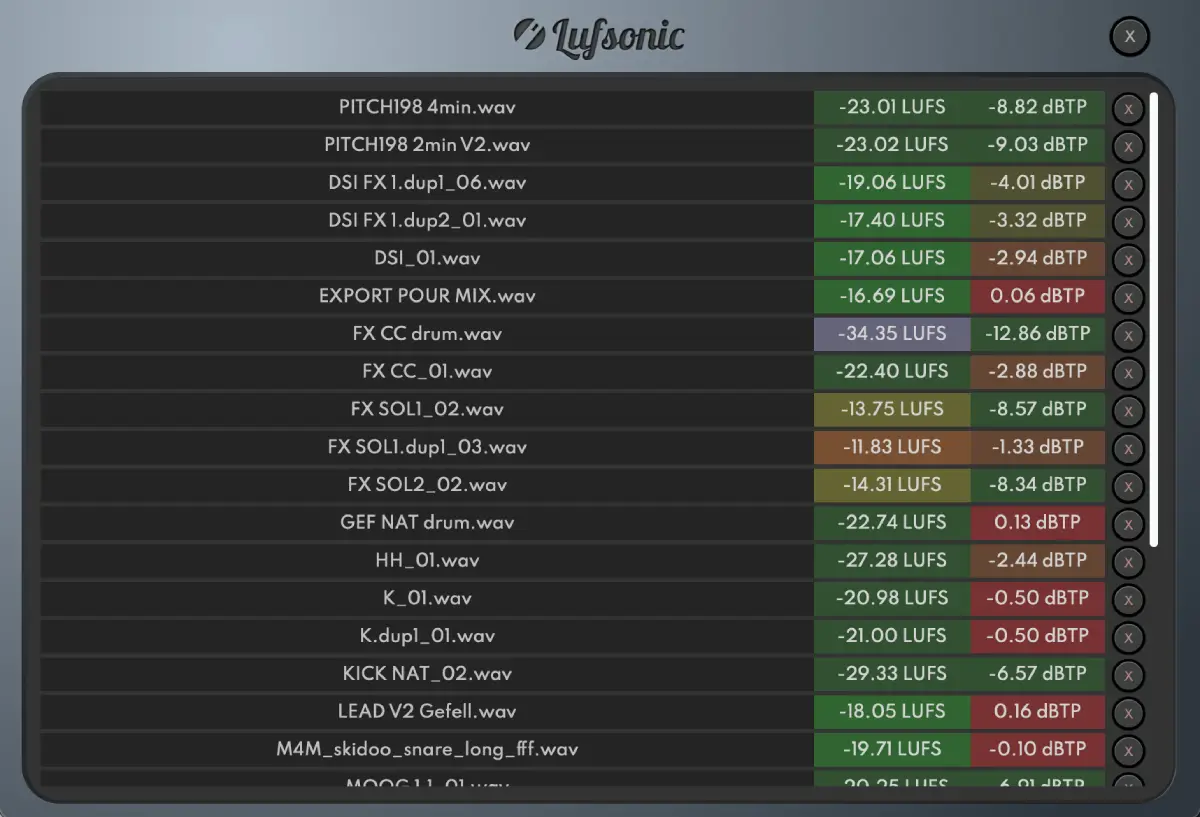
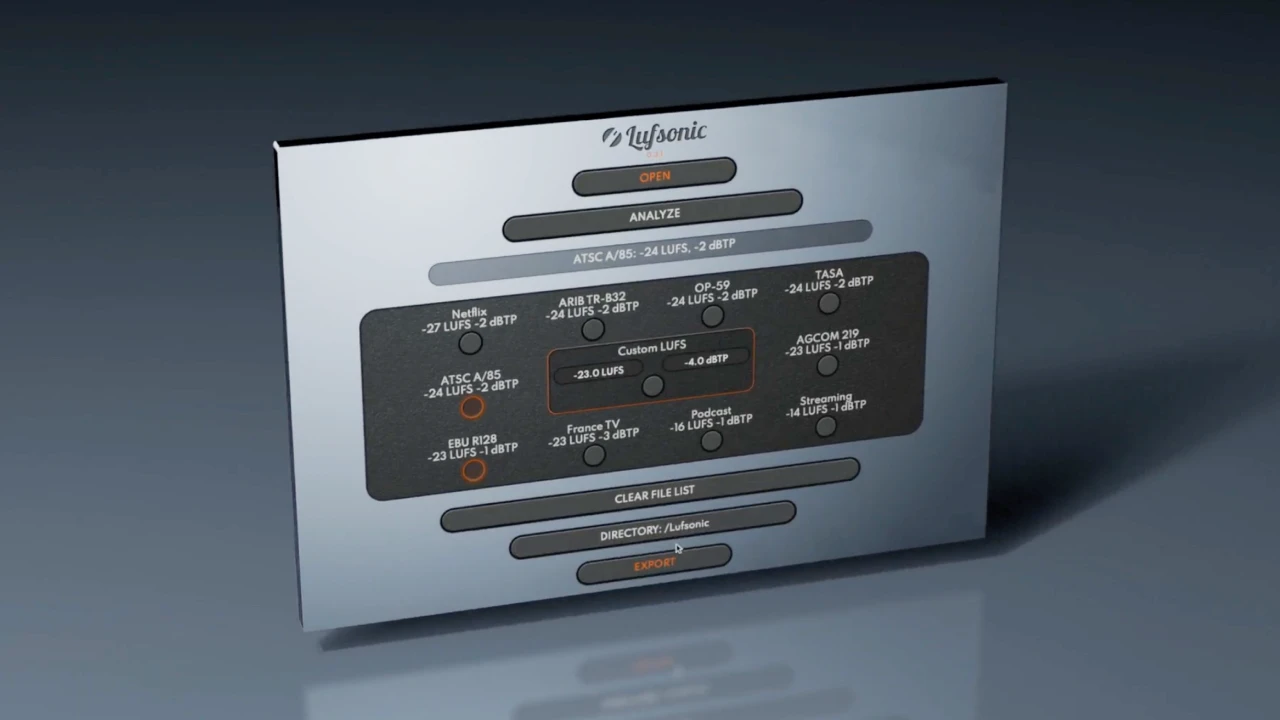
For broadcast, film or a podcast season, measuring is not enough: the files must be corrected. Lufsonic does it in three steps: drag the files, choose the delivery format (Netflix, EBU R128, ATSC, ARIB TR-B32, OP-59, TASA, AGCOM, France TV, Podcast, Streaming, or a custom LUFS and dBTP target), and export normalized files with a report, in batch.
Lufsonic
Analyze and normalize dozens of audio files in seconds.
$49 $98 -50%
Standalone app · Windows & macOS
See LufsonicIn short
For music streaming, stop chasing loudness: platforms turn loud masters down, so master for the sound and keep a safe true peak. For TV, film and podcasts, deliver exactly to the spec and check every file. See also the best loudness meters, the best broadcast loudness tools and our comparison Lufsonic vs Youlean.
Frequently asked questions
What LUFS should I master to for Spotify?
Spotify normalizes to -14 LUFS integrated by default and recommends a true peak of -1 dBTP maximum, or below -2 dBTP if your master is louder than -14 LUFS. Louder masters are simply turned down at playback.
Do I need a different master for each streaming platform?
Usually not. Platforms turn loud masters down to their reference level. One master that sounds good, with a safe true peak, works everywhere. Separate masters make sense for broadcast, film and podcasts, which have strict delivery specs.
What is the loudness standard for TV?
In Europe, EBU R128 asks for -23 LUFS with a true peak of -1 dBTP. In the United States, ATSC A/85 asks for -24 LKFS with -2 dBTP. Netflix asks for -27 LKFS dialogue-gated (±2) with -2 dBTP.