A market flooded with compressors
There have never been so many compressors: vintage hardware emulations, ultra-precise digital tools, all-in-one bus compressors. The problem is no longer finding a good compressor, but knowing which one really serves your music, without stacking five different ones in every session.
In this comparison we put Anodyn up against the standards found in most studios, looking at what each one does best.

How to compare compressors properly
Comparing compressors is tricky, because a compressor changes the volume, and our ears always prefer the louder one. For a fair comparison:
- Match output levels (in LUFS) before listening.
- Aim for the same gain reduction (for example 3 to 4 dB on a vocal).
- Test several sources: vocals, drums, bass, a full mix.
- Listen blind if you can, without looking at the interface.
A tool like Diffonic automates level matching and blind testing, which makes this kind of comparison far more reliable.
The market standards
FabFilter Pro-C 3: precision

Pro-C 3, the successor to the widely used Pro-C 2, is the reference for transparent digital compression: several compression styles, a very informative display and detailed control over every parameter.
- Pros: precision, visual feedback, full sidechain, versatility.
- Cons: lots of settings, and a fairly neutral sound when you're after colour.
Waves SSL G-Master Buss Compressor: the glue

The SSL G-Master reproduces the famous bus compressor from SSL consoles. It's one of the most used plugins for gluing a mix.
- Pros: a sound proven on countless records, very simple, instant on a bus.
- Cons: a single character, designed above all for buses.
1176 emulations: the fast FET

Universal Audio's 1176 collection recreates the classic FET compressor: very fast, and loved on vocals, bass and snare.
- Pros: energetic attack, instantly recognisable colour.
- Cons: fixed behaviour; it always colours, even when you'd like to stay discreet.
Native Instruments Solid Bus Comp: simplicity
Solid Bus Comp takes a classic approach to bus compression with a clear interface. Komplete users often already have it.
- Pros: fast, effective, often already installed.
- Cons: less personality and fewer fine controls than the others.
Anodyn: one compressor, every shade
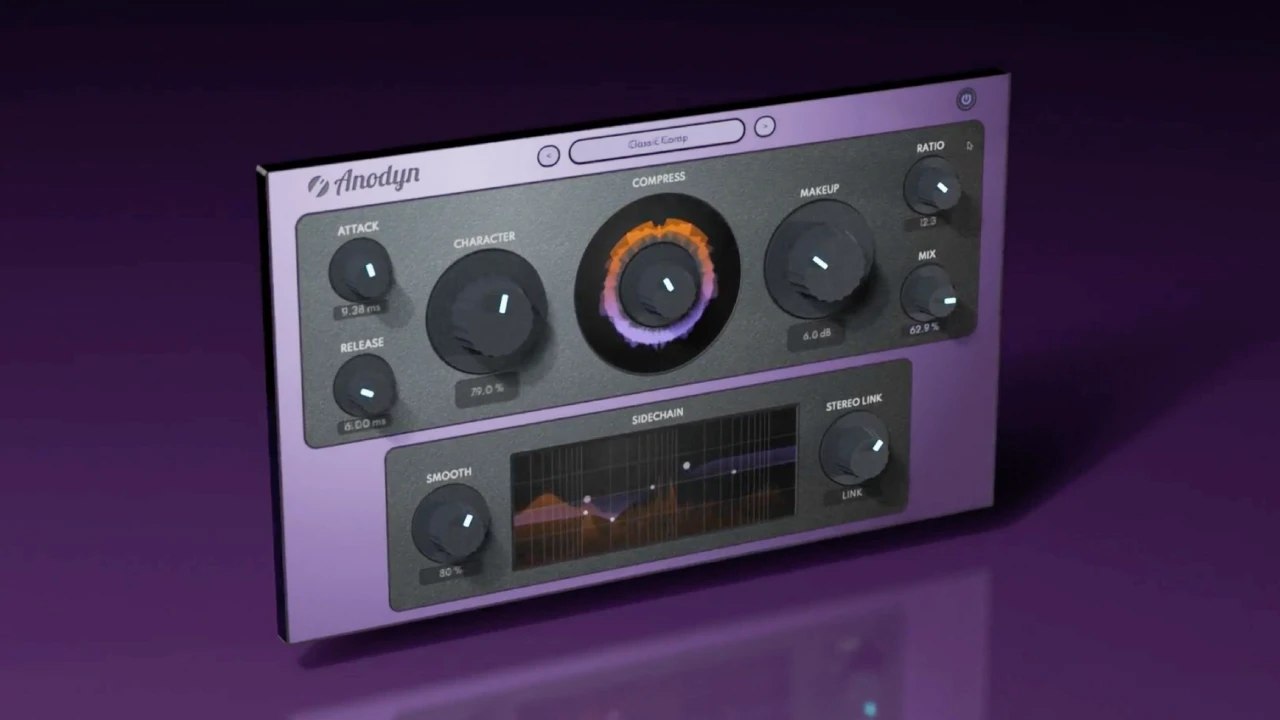
Where each standard excels in one specific area, Anodyn bets on flexibility: a single compressor that goes from transparent to heavily coloured, and moves from a vocal to a stereo bus without changing tools.
- CHARACTER: from clean to rich in harmonics. At low settings the effect is subtle and musical; at maximum it's like stacking several compressors to intensify the colour.
- SMOOTH: sets how the compressor reacts. To the left, fast, precise, modern detection; to the right, a softer, more "vintage" response.
- SIDECHAIN EQ: an EQ in the detection path, to stop the low end from making the compressor pump, or to target a specific range.
- STEREO LINK: a continuous control between dual mono and linked stereo, so you decide whether each channel lives its own life or both react together.
In practice, it's the compressor you can leave on almost every track in a session: no more switching from a 1176 to an SSL to a transparent compressor to get three different behaviours.
Anodyn
One compressor, every color: from transparent to vintage.
$59 $118 -50%
VST3 · AU · AAX · Windows & macOS
See AnodynThe right compressor for each source
Vocals
For a pop vocal, Anodyn with CHARACTER around 25%, a 3:1 ratio and SMOOTH in the middle gives a steady, present vocal without artefacts. The 1176 is the right choice if you want aggressive, fast colour; Pro-C 3 if you want total transparency.
Drums
On a snare or a drum bus, Anodyn with a high CHARACTER adds body and density; the SIDECHAIN EQ stops the kick from triggering all the compression. The SSL G-Master remains a safe bet for gluing a drum bus.
Mix bus
For the master bus: a low ratio (1.5:1 to 2:1), 1 to 2 dB of reduction and STEREO LINK at maximum. Anodyn with a low CHARACTER brings cohesion without changing the balance; the SSL G-Master gives the classic "console" colour.
Summary
| Compressor | Strength | Ideal for |
|---|---|---|
| Anodyn | Transparent to coloured in one plugin | Every source, from vocals to the bus |
| Pro-C 3 | Precision and visual feedback | Transparent control, mastering |
| SSL G-Master | Classic bus glue | Mix bus, drum bus |
| 1176 | Fast attack, FET colour | Vocals, bass, snare |
| Solid Bus Comp | Simplicity | Buses, Komplete users |
Conclusion
Each standard has its place: Pro-C 3 for precision, the SSL for glue, the 1176 for FET colour. But if you want one compressor that covers all those needs, Anodyn is our first choice for 2027, thanks to CHARACTER, SMOOTH, SIDECHAIN EQ and STEREO LINK.
Pair it with Anadrive for saturation and Reverbia for space, and you have a complete mixing chain. To go further, see our comparison of the best compressors of 2027.