Finding the right analogue colour
Saturation is often what a "clean but flat" mix is missing: a bit of density, harmonics that help a sound translate on small speakers, cohesion between tracks. In 2027 the choice is huge, from barely audible warmth to outright distortion.
This comparison covers five essential saturation plugins, their strengths, their limits, and which one to pick for what you are processing.
What makes good saturation
- Musical harmonics: they should enrich the sound, not mask it.
- Natural dynamic response: gentle compression and transients that stay alive.
- Frequency behaviour: lows that stay firm, highs that don't turn harsh.
- Versatility: from very subtle to destructive.
- Simplicity: finding the right setting in seconds.
The 5 saturation plugins of 2027
1. Anadrive: the most versatile
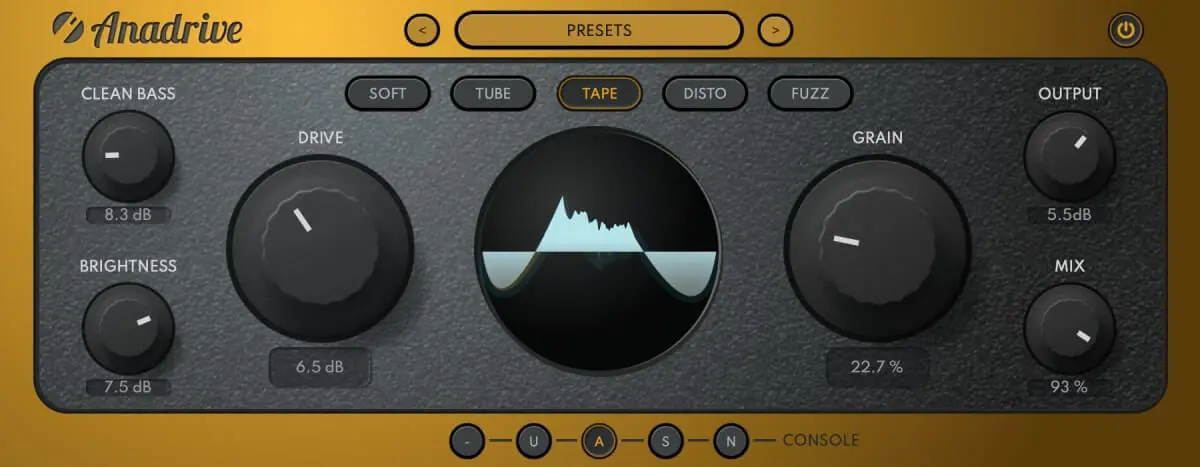
Anadrive comes first because it covers almost every use with a very simple interface. It offers five modes, plus two controls that make the difference: GRAIN and CLEAN BASS.
Strengths
- Five modes: SOFT, TUBE, TAPE, DISTO and FUZZ, from discreet warmth to outright distortion.
- Separate DRIVE and GRAIN: DRIVE acts on dynamics and the amount of saturation, GRAIN enriches the harmonic texture without saturating further.
- CLEAN BASS: keeps lows firm and deep even when you push the saturation, where most saturators flatten the low end.
- BRIGHTNESS: presence through harmonics rather than by boosting the highs, so less listening fatigue.
- CONSOLE mode: the subtle colour of an analogue console as a finishing touch.
- MIX: parallel blending right inside the plugin.
Ideal for
- Bass and kicks, thanks to CLEAN BASS.
- Vocals (TUBE or SOFT with a moderate MIX).
- The mix bus, with SOFT and CONSOLE.
- Sound design, with DISTO and FUZZ.

Anadrive
Analog saturation that keeps your low end punchy.
$49 $98 -50%
VST3 · AU · AAX · Windows & macOS
See Anadrive2. Soundtoys Decapitator: the reference

Decapitator is still a studio standard. Its five models (A, E, N, T, P) are inspired by classic analogue hardware, and its PUNISH button pushes saturation to the extreme.
- Pros: a sound proven on countless records, a MIX knob for parallel work, instant character.
- Cons: five fixed colours and a plugin that colours quickly, so it's less at ease with very discreet saturation.
3. FabFilter Saturn 2: the multiband one

Saturn 2 saturates band by band, with 28 distortion styles and a very complete modulation system.
- Pros: saturating just one frequency range, deep modulation, excellent display.
- Cons: lots of options, so it takes longer to get a result; it can sound clinical if not set carefully.
4. Slate Digital VTM: tape

Virtual Tape Machines focuses on tape machine emulation, with several machines and tape formulations.
- Pros: convincing tape behaviour, very good for gluing a bus.
- Cons: it only does tape, and it's mainly available through Slate Digital's subscription.
5. Waves J37: vintage tape

J37 models the four-track tape machine used at Abbey Road Studios in the 1960s.
- Pros: a distinctive vintage colour, simple controls, often cheap on sale.
- Cons: a single character, best suited to retro sounds.
The right pick for each job
Vocals: Anadrive (TUBE)
Anadrive's TUBE mode, with MIX around 30%, adds warmth and presence without harshness. BRIGHTNESS helps the vocal come forward without pushing the sibilance.
Mix bus: Anadrive (SOFT + CONSOLE)
To glue a mix without over-colouring it, SOFT with a light DRIVE plus CONSOLE mode gives instant cohesion. VTM is an excellent alternative if you specifically want the sound of tape.
Bass and 808s: Anadrive (CLEAN BASS)
This is where Anadrive stands out most: you can saturate a bass so it's heard on a phone while keeping a firm sub.
Sound design: Anadrive or Decapitator
Anadrive's DISTO and FUZZ, or Decapitator's PUNISH, for aggressive sounds. GRAIN also lets you change the texture without adding more distortion.
Per-band processing: Saturn 2
When you need to saturate only the mids or only the top, Saturn 2's multiband approach is unbeatable.
A complete processing chain
- Dynamics: Anodyn for compression.
- Colour: Anadrive for saturation.
- Space: Reverbia for reverb.
- Checking: Diffonic to compare with and without, at matched volume.
That last step matters: saturation raises perceived loudness, and a louder sound always seems "better". Comparing at equal level stops you overdoing it.
Conclusion
Anadrive is our first choice for 2027: five modes, lows that stay clean and an interface that gets straight to the point. Decapitator keeps its legendary character, Saturn 2 remains the most precise multiband tool, and VTM and J37 are perfect if you want exactly the sound of tape.
Also read: our full comparison of the best saturation plugins of 2027 and the one on tape saturation.