Digital reverb in 2027
A good reverb no longer just imitates a room. Today's plugins range from pure realism to sound design, and most of them include what you used to add around them: EQ, saturation, ducking, modulation. Whether you produce electronic music, mix a vocal or build an ambient pad, the reverb you choose really changes the depth and clarity of a track.
This guide covers the reverbs that matter in 2027, from Reverbia to the classics found in every studio.
What makes a good reverb
Before the recommendations, here are the criteria we used:
- Sound: a dense, smooth tail that doesn't cloud the mix.
- Control: more than size and decay time.
- CPU: being able to open several instances without slowing the session down.
- Character: from clean digital to vintage colour.
- Built-in tools: EQ, ducking and modulation, so you don't have to stack plugins around it.
1. Reverbia: the most versatile
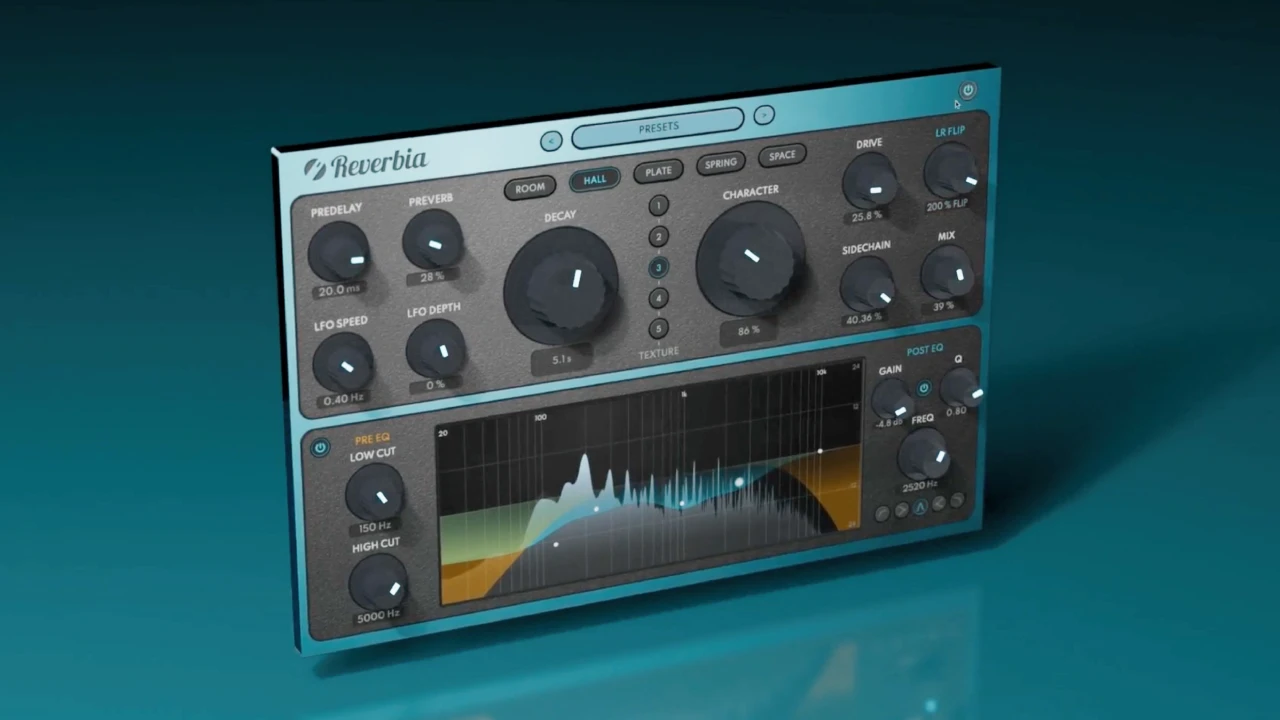
Top of our list, Reverbia brings together 25 reverbs: five families (ROOM, HALL, PLATE, SPRING, SPACE), each with five very different variations. Its real strength is how quickly you can dial it in.

Reverbia: 25 reverbs, a CHARACTER knob and built-in drive.
What sets it apart
- 25 reverbs: from a small room to a huge unreal space, plus plate and spring.
- The CHARACTER knob: it moves the reverb from realism towards a wider, denser, more unreal sound.
- Built-in drive: grit straight into the tail, with several saturation types.
- Dual EQ: one EQ before the reverb to keep only what matters, another after it to shape the tail.
- Stereo width: from mono-safe to very wide, with channel swap.
- Sidechain: the reverb steps back while the source plays (ducking); a double-click switches it to compressor mode.
- Hidden features: shimmer, tempo-synced predelay and decay, LFO and tremolo.
In practice you pick a type, set CHARACTER to the amount of realism you want, then shape the tail with the EQ and ducking. You get a musical space fast, without spending ten minutes in the parameters.
Where it shines
- Vocals, with ducking to keep the words clear.
- Electronic music, where shimmer, LFO and drive become effects in their own right.
- Dense arrangements, thanks to the dual EQ that keeps the low mids clean.
- Bus and group sends, when one reverb has to glue a whole section together.
Reverbia
The all-in-one reverb: 25 reverbs, from realistic rooms to otherworldly spaces.
$79 $158 -50%
VST3 · AU · AAX · Windows & macOS
See Reverbia2. The classics still on top
Valhalla VintageVerb

VintageVerb is still a staple in 2027. Its algorithms, inspired by the machines of the 70s and 80s, have an instantly musical colour at a very low price.
FabFilter Pro-R 2
Pro-R 2 is the go-to for engineers who want full control: decay adjustable per frequency band, precise stereo placement and a very transparent sound.
Lexicon PCM Native Reverb Bundle

The Lexicon algorithms defined the sound of studio reverb for decades. They are still widely used in post-production and broadcast.
3. More specialised tools
Eventide UltraReverb

UltraReverb brings Eventide's know-how in modulation and pitch: ideal for textures a classic reverb can't make.
Audio Ease Altiverb 8
For convolution, Altiverb 8's impulse response library remains the reference when you need to recreate a real place: a church, a famous studio, a concert hall.
Choosing for the way you work
There is no "best" reverb in absolute terms, only the one that suits your music.
Electronic music
Look for modulation and extreme settings. Reverbia is at home here with its shimmer, LFO and drive; so is UltraReverb.
Mixing
What counts: transparency, low CPU and precision. Pro-R 2 is built for this. Reverbia gets close when you keep CHARACTER to the left and clean the tail with its two EQs.
Songwriting
The priority is getting an inspiring sound quickly. Simple interfaces like VintageVerb's or Reverbia's keep the creative flow going.
A reverb that does more than reverb
Recent reverbs include what used to be loaded as separate plugins: an EQ to cut the lows, a sidechain compressor for ducking, saturation to dirty up the tail. The result: shorter chains and a lighter session.
Reverbia follows this logic: pre and post EQ, drive, ducking and stereo width all live in the same window.
Conclusion
The choice has never been wider. Reverbia comes first for its versatility and speed, VintageVerb for value for money, Pro-R 2 for precision and Altiverb for real spaces.
The safest approach is still to try several reverbs on your own tracks, at matched volume, and keep the one that sounds best to your ears.
Further reading: our comparison of the best reverbs of 2027, the guide to compression and the one on analogue saturation.