The principle
Parallel compression means blending an uncompressed signal with a heavily compressed copy of the same signal. The original keeps its transients and natural dynamics; the compressed copy adds density and sustain. Together they give a bigger, more present sound, without the "squashed" effect of heavy compression on the track itself.
Setting it up with Anodyn
- Create an aux bus (or return track) and send the track or group you want to process to it.
- Insert Anodyn on that bus.
- Set it hard: high ratio, fast attack, lots of gain reduction (10 dB or more).
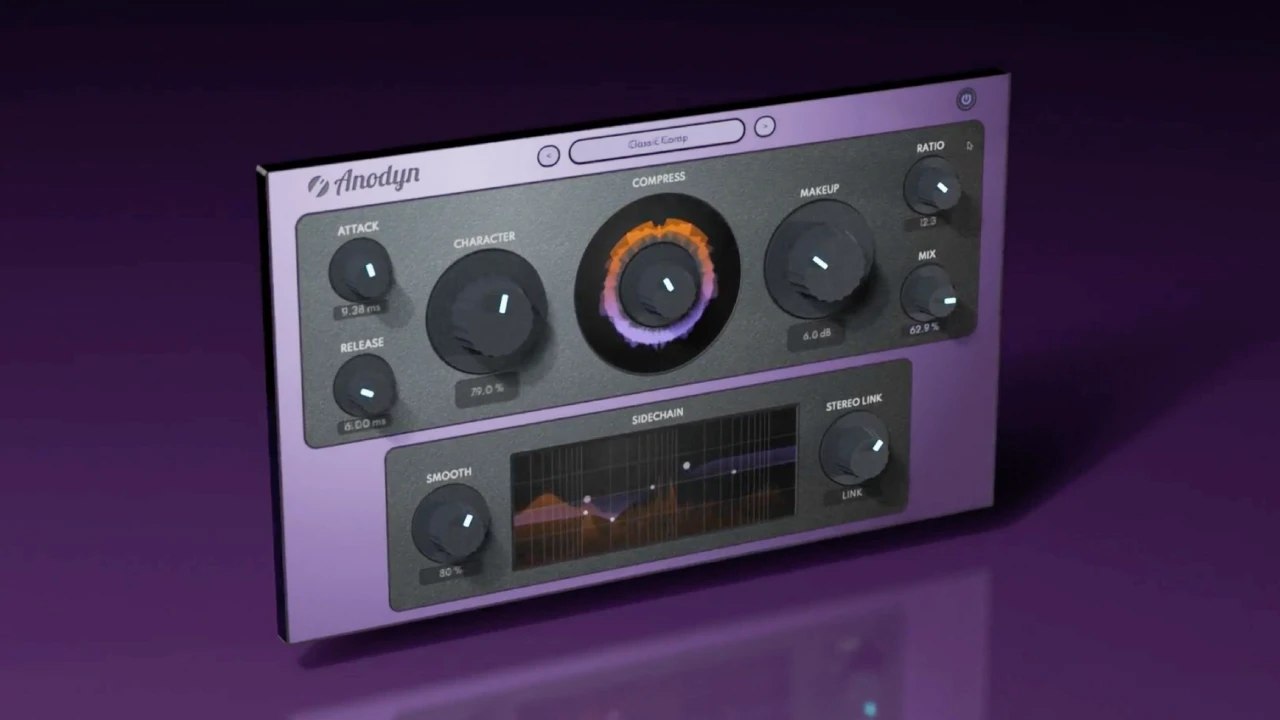
- Choose the colour with CHARACTER: low for neutral parallel compression, high to add harmonics and thickness.
- Blend: raise the parallel bus until you feel the density, then pull it back a little.
Make sure latency is compensated if your DAW doesn't do it automatically, so both signals stay perfectly aligned.
Anodyn
One compressor, every color: from transparent to vintage.
$59 $118 -50%
VST3 · AU · AAX · Windows & macOS
See AnodynDrums
This is the best-known use. Send the drum group to the parallel bus:
- kick and snare gain punch and presence;
- the kit becomes more cohesive, more "glued";
- transients stay intact thanks to the original signal.
With Anodyn, the SIDECHAIN EQ is useful here: by reducing the lows in the detection, you stop the kick from triggering all the compression and making the bus pump.
Vocals
On a vocal, parallel compression steadies the level and brings it to the front of the mix while keeping its expressiveness. Set the compressed copy a little less extreme than for drums, and use SMOOTH to the right for a softer response that follows the phrasing.
Mix bus
On the whole mix, parallel compression must stay discreet: a few percent of the parallel bus is enough for cohesion and impact. STEREO LINK at maximum keeps the stereo image stable.
Advanced techniques
Parallel by frequency range
Filter the parallel bus (for example by cutting the lows) to thicken only the mids and highs: drums gain presence without the low end turning muddy.
Automating the blend
Lower the parallel bus in the verses and raise it in the choruses: the track gains contrast and energy where it needs it.
Starting points
| Use | Anodyn settings on the bus | Amount |
|---|---|---|
| Drums | High ratio, fast attack, medium to high CHARACTER, SIDECHAIN EQ on the lows | Obvious |
| Vocals | High ratio, SMOOTH to the right, CHARACTER to taste | Moderate |
| Mix bus | High ratio, low CHARACTER, STEREO LINK at maximum | Very light |
Check it
Parallel compression raises perceived loudness, which always makes it seem "better". Compare with and without at matched volume using Diffonic to be sure the added density really serves the track.
In short
A bus, Anodyn set hard, CHARACTER for colour and a blend set by ear: parallel compression is one of the simplest ways to add weight to drums or a vocal. To go further, see our guide to compression with Anodyn and our comparison of the best compressors of 2027.